Industrial electronics manufacturing is the process of designing, assembling, testing, and inspecting electronic products used in factories, machinery, transportation, energy systems, communications, medical equipment, and other technical environments. Unlike simple consumer electronics, industrial electronic products often need to operate reliably under vibration, temperature changes, dust, electrical noise, and continuous workloads.
The manufacturing process brings together several disciplines, including PCB manufacturing, electronic component assembly, surface-mount technology (SMT), through-hole assembly, soldering, testing, inspection, and quality management.
The basic manufacturing flow can be represented as:
Design → Material Preparation → PCB Assembly → Inspection → Testing → Final Assembly → Quality Documentation
Materials commonly used include:
- Copper for conductive paths and PCB layers
- FR-4 and other laminate materials for circuit boards
- Silicon-based semiconductor components
- Solder alloys for electrical connections
- Aluminum and copper for thermal management
- Plastics and engineering polymers for housings
- Ceramic materials for specialized electronic components
- Adhesives, coatings, and thermal interface materials
The objective is to create electronic assemblies that meet defined electrical, mechanical, thermal, and reliability requirements.
Why Electronics Manufacturing Matters
Industrial electronics are increasingly connected to automation, data collection, energy management, robotics, and digital control systems. A failure in an electronic control board can affect an entire production process, which makes manufacturing quality particularly important.
The topic affects:
- Industrial automation manufacturers
- Factory operators
- Automotive and transportation industries
- Energy and power infrastructure
- Telecommunications equipment
- Medical and laboratory equipment
- Robotics and machine-control applications
- Industrial Internet of Things (IIoT) systems
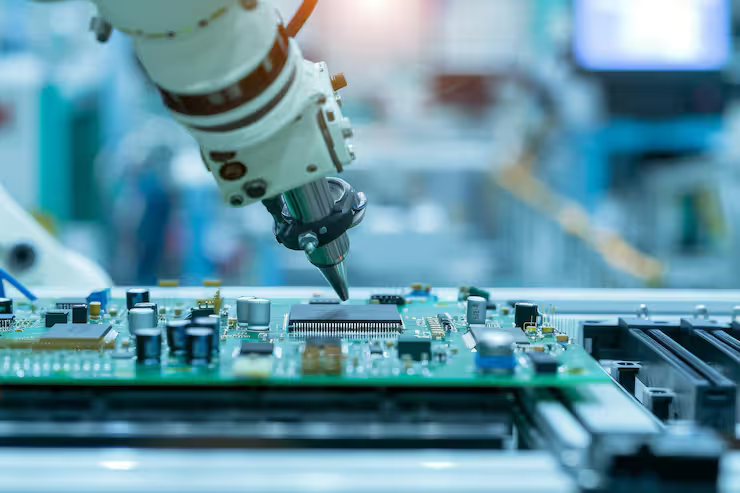
Modern electronics manufacturing processes help address several technical challenges. Automated assembly can improve placement consistency, while automated optical inspection can identify visible defects more systematically than manual inspection alone.
Thermal design is also important. High-power components can generate significant heat, so manufacturers may use heat sinks, thermal pads, copper planes, forced-air cooling, or other thermal management techniques.
Major Manufacturing Technologies
| Technology | Main Purpose | Typical Application |
|---|---|---|
| SMT | Places compact components directly on PCBs | Control boards, sensors |
| Through-hole assembly | Mounts components through PCB holes | High-mechanical-strength assemblies |
| Reflow soldering | Joins SMT components to PCB pads | Automated PCB assembly |
| Wave soldering | Soldering of through-hole components | High-volume assembly |
| AOI | Detects visible assembly defects | PCB quality inspection |
| X-ray inspection | Examines hidden solder joints | BGA and complex assemblies |
| Functional testing | Verifies operating behavior | Industrial control equipment |
| Environmental testing | Evaluates performance under conditions | High-reliability electronics |
Recent Developments in Electronics Manufacturing
Industrial electronics manufacturing has continued moving toward automation, connected production systems, semiconductor localization, and more advanced quality monitoring.
In May 2026, India's Ministry of Electronics and Information Technology reported that 12 semiconductor manufacturing units and 24 semiconductor design companies had been approved for fiscal support under the Semicon India Programme. The same update reported cumulative production of ₹11,31,358 crore under the Production Linked Incentive scheme for large-scale electronics manufacturing through March 2026.
These developments indicate continued expansion of India's electronics and semiconductor manufacturing ecosystem.
Another important trend is the increasing use of data-driven manufacturing. Production equipment can collect information about soldering temperatures, component placement, inspection results, machine conditions, and process deviations. Manufacturers can use this information to identify recurring problems earlier.
Automation and Smart Manufacturing
Industrial automation is becoming more closely connected with electronics production. Modern factories may combine:
- Automated component placement
- Robotic material handling
- Machine vision
- Automated optical inspection
- Manufacturing execution systems
- Digital production records
- Predictive equipment monitoring
- Statistical process control
Artificial intelligence and machine learning can also support image analysis and anomaly detection. These technologies do not eliminate the need for engineering judgment; instead, they can help organize and analyze large quantities of manufacturing data.
Advances in PCB and Component Technology
Electronics are becoming smaller and more functionally dense. High-density interconnect PCBs, flexible circuits, advanced semiconductor packages, and smaller passive components allow manufacturers to place more functionality into limited physical space.
Quality requirements have also evolved. IPC reported the release of IPC-A-610J and IPC J-STD-001J in April 2024, covering electronic assembly acceptance and soldered assembly requirements. IPC's revision table also records IPC-A-600M in May 2025 for printed-board acceptability.
These standards are useful references when establishing manufacturing and inspection criteria.
Materials Used in Industrial Electronics
Material selection affects electrical performance, durability, thermal behavior, and manufacturing reliability.
Printed Circuit Board Materials
FR-4 remains widely used for conventional rigid PCBs because of its combination of electrical insulation, mechanical strength, and manufacturability. Other laminate systems may be selected for high-frequency, high-temperature, flexible, or high-speed applications.
Electronic Components
Industrial assemblies may contain:
- Microcontrollers
- Microprocessors
- Power semiconductors
- Resistors
- Capacitors
- Inductors
- Connectors
- Sensors
- Relays
- Diodes
- Transistors
- Integrated circuits
Component selection depends on electrical ratings, temperature range, mechanical requirements, expected operating environment, and product design specifications.
Solder and Thermal Materials
Lead-free solder alloys are widely used in modern electronics manufacturing. Thermal interface materials help transfer heat from components to heat sinks or other cooling structures.
Material traceability is important because changes in solder, PCB laminates, components, coatings, or adhesives can affect manufacturing results.
Quality Control in Electronics Manufacturing
Quality control begins before physical assembly. Engineers review the design, component specifications, PCB layout, manufacturing tolerances, and test requirements.
A typical quality-control system may include:
- Incoming material inspection
- Component verification
- PCB inspection
- Solder-paste inspection
- Automated optical inspection
- X-ray inspection
- Electrical testing
- Functional testing
- Environmental testing
- Final inspection
- Traceability documentation
Design for Manufacturing (DFM) is particularly important. A PCB may work correctly in a prototype but become difficult to manufacture consistently if component spacing, thermal design, tolerances, or soldering requirements are unsuitable.
IPC provides standards and DFM resources covering different stages of electronics development and manufacturing.
Common Defects and Their Causes
| Defect | Possible Cause | Typical Detection |
| Solder bridge | Excess solder or incorrect placement | AOI |
| Insufficient solder | Poor paste deposition | SPI/AOI |
| Component misalignment | Placement error | AOI |
| Voids | Soldering conditions | X-ray |
| Open circuit | Weak or missing connection | Electrical test |
| Wrong component | Material or placement error | Component verification |
| PCB damage | Handling or process issue | Visual inspection |
| Overheating | Poor thermal design | Thermal testing |
A strong electronics quality control program combines process monitoring with testing rather than relying only on final inspection.
Laws, Regulations, and Government Programs in India
Industrial electronics manufacturing in India operates within several regulatory areas, including environmental management, electronic waste, product requirements, workplace rules, and industry-specific standards.
The E-Waste (Management) Rules, 2022 establish Extended Producer Responsibility requirements for covered electrical and electronic equipment. The Central Pollution Control Board explains that the framework includes recycling obligations, registered recyclers, EPR certificates, returns, and audits.
India has also introduced programs aimed at strengthening domestic electronics manufacturing. The Electronics Component Manufacturing Scheme (ECMS) was approved by the Union Cabinet on March 28, 2025, and notified on April 8, 2025. Its objective is to develop a stronger component manufacturing ecosystem across targeted parts of the electronics value chain.
MeitY's current electronics programs also include the Semiconductor and Display Manufacturing ecosystem, PLI programs, SPECS, and electronics manufacturing cluster initiatives.
Regulatory requirements can vary according to the type of electronic equipment, its intended market, materials used, and environmental impact. Manufacturers should therefore verify the latest requirements applicable to their specific product category.
Useful Tools and Resources
Several technical resources can help readers understand and manage electronics manufacturing processes.
PCB Design and Engineering Tools
Common categories include:
- PCB design software for circuit layout
- Circuit simulation tools
- Bill-of-materials management tools
- Thermal analysis software
- Component libraries
- Design-rule checking tools
These resources can help engineers identify layout and manufacturing problems before physical production.
Manufacturing and Quality Resources
Useful resources include:
- IPC standards and technical documents
- PCB design-for-manufacturing guidelines
- Automated optical inspection systems
- Solder-paste inspection systems
- X-ray inspection equipment
- Electrical test equipment
- Statistical process-control templates
- Manufacturing traceability systems
IPC maintains a large collection of electronics manufacturing standards and regularly updates its document revision information.
For India-specific information, MeitY and the Central Pollution Control Board are useful references for electronics manufacturing programs and e-waste requirements.
Frequently Asked Questions
What are the main steps in electronics manufacturing?
The process generally includes product design, PCB fabrication, component preparation, SMT or through-hole assembly, soldering, inspection, electrical testing, functional testing, final assembly, and documentation.
What is SMT in electronics manufacturing?
Surface-mount technology places electronic components directly onto pads on the surface of a printed circuit board. It supports compact designs and automated assembly.
Why is PCB quality control important?
A PCB connects and supports many electronic components. Manufacturing defects such as solder bridges, open connections, incorrect components, or damaged traces can affect electrical performance and reliability.
What is AOI in electronics manufacturing?
Automated Optical Inspection uses cameras and image-processing techniques to examine assembled circuit boards for visible defects such as misplaced components, solder problems, and polarity errors.
Why are electronics manufacturing standards important?
Standards establish consistent technical and quality criteria. For example, IPC-A-610 addresses acceptability requirements for electronic assemblies, while IPC J-STD-001 addresses soldered electrical and electronic assemblies.
Conclusion
Industrial electronics manufacturing combines electronic design, materials science, automated assembly, soldering technology, inspection, testing, and quality management. The process has become increasingly sophisticated as industrial equipment requires smaller, smarter, and more reliable electronic systems.
Recent developments in India's semiconductor and electronics ecosystem, together with advances in automation and PCB technology, are influencing how electronic products are designed and manufactured.
For manufacturers and technical readers, understanding electronics manufacturing processes, PCB assembly, electronic components, manufacturing automation, and quality control provides a useful foundation for evaluating how modern industrial electronic systems are produced and tested.