Factory automation refers to the use of control systems, industrial machinery, software, sensors, robotics, and computer-based technologies to perform manufacturing and production activities with reduced manual intervention. It is an important part of modern manufacturing because factories increasingly depend on connected equipment and automated processes to manage repetitive, precise, and data-intensive operations.
Modern factory automation can include programmable logic controllers (PLCs), industrial robots, machine vision systems, sensors, motor drives, human-machine interfaces (HMIs), supervisory control and data acquisition (SCADA) systems, and manufacturing software. These technologies can work together to monitor equipment, control production processes, collect operational data, and support consistent manufacturing workflows.
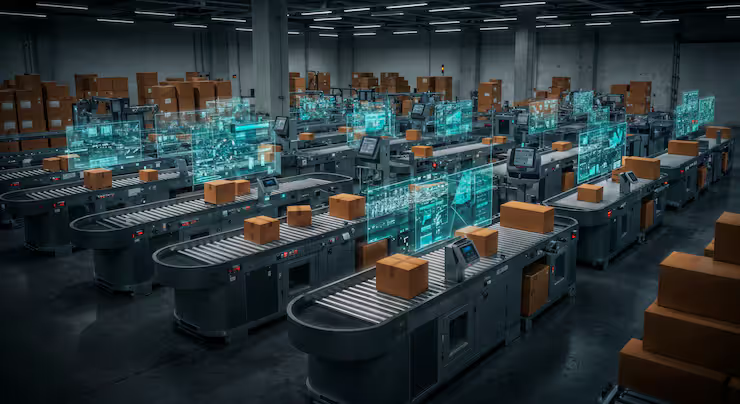
Why Is Factory Automation Important?
Factory automation has become increasingly relevant as manufacturers look for ways to improve production processes and manage increasingly complex industrial environments. Automated systems can perform repetitive activities continuously according to programmed instructions, while sensors and control systems can provide information about equipment and production conditions.
Another important aspect is process consistency. Automated machinery can follow predefined operating parameters, which can help reduce variations associated with repetitive manual tasks. In sectors such as automotive manufacturing, electronics, pharmaceuticals, food processing, and industrial machinery, consistent production processes are particularly important.
Automation also generates operational data. Production information collected from machines and sensors can help engineering and management teams understand equipment performance, production patterns, downtime, and maintenance requirements.
Main Components of Factory Automation
Programmable Logic Controllers
A programmable logic controller, commonly called a PLC, is a central component in many industrial automation systems. PLCs receive information from sensors and other input devices and execute programmed instructions to control machinery.
PLC automation is widely used because the controllers can be programmed for different manufacturing processes. Depending on the application, a PLC may control conveyors, motors, valves, robotic equipment, packaging machinery, or production lines.
Industrial Robots
Industrial robots are programmable machines designed to perform specific manufacturing tasks. Common applications include material handling, welding, assembly, painting, packaging, and machine tending.
Robotic automation can be particularly useful for repetitive processes where consistent movement and positioning are required. Collaborative robots, often called cobots, are another category designed for applications where people and robotic systems may operate in closer proximity under appropriate safety controls.
Sensors and Industrial Devices
Sensors provide information about physical conditions within a production environment. Temperature, pressure, proximity, position, vibration, flow, and optical sensors are examples commonly found in industrial systems.
The information collected by sensors can be used by PLCs, industrial computers, and other control systems to make decisions according to programmed parameters.
Human-Machine Interfaces
A Human-Machine Interface, or HMI, provides a visual interface through which operators can monitor and interact with industrial equipment. An HMI can display machine status, process information, alarms, measurements, and other operational data.
Modern HMI systems can connect with PLCs and industrial networks, providing operators with a centralized view of important production information.
SCADA Systems
Supervisory Control and Data Acquisition systems are used to monitor and supervise industrial processes. SCADA platforms can collect data from equipment distributed across a factory and present it through dashboards or operator interfaces.
SCADA technology is commonly associated with manufacturing, utilities, energy infrastructure, and other industrial environments where centralized monitoring is important.
Types of Factory Automation
Fixed Automation
Fixed automation is designed for production processes that remain relatively stable over long periods. Specialized machinery performs predefined operations with limited flexibility.
This approach can be appropriate for high-volume manufacturing where the same product or process is repeated frequently.
Programmable Automation
Programmable automation allows equipment to be reprogrammed for different production requirements. It can be useful when manufacturers produce different batches or product variations.
Control software and PLC systems allow production parameters to be modified without completely replacing the automation infrastructure.
Flexible Automation
Flexible automation combines automated equipment with software and control technologies that allow production systems to accommodate product variations. It is commonly associated with manufacturing environments where product specifications may change regularly.
Integrated Automation
Integrated automation connects multiple production technologies into a coordinated system. Machines, PLCs, robots, sensors, software, databases, and industrial communication networks can exchange information as part of a larger manufacturing architecture.
Factory Automation and Industry 4.0
Factory automation is closely connected with Industry 4.0, which describes the increasing integration of digital technologies into manufacturing. Industry 4.0 commonly involves industrial IoT, cloud computing, artificial intelligence, data analytics, connected machinery, and advanced automation.
Industrial IoT allows machines and sensors to communicate operational information across connected networks. This can create a more detailed picture of factory performance and help organizations identify production patterns.
Cloud-based industrial platforms can also provide centralized access to selected manufacturing information. Depending on the architecture, data may be used for reporting, maintenance analysis, production planning, and other business processes.
Benefits of Factory Automation
One important benefit of factory automation is improved process consistency. Automated systems can execute predefined sequences repeatedly, helping manufacturers maintain standardized operating procedures.
Automation can also support productivity by allowing machines to perform repetitive operations according to programmed schedules. However, actual productivity depends on equipment design, process integration, maintenance, workforce skills, and other operational factors.
Another benefit is improved data visibility. Connected machines and industrial sensors can provide information that may previously have been recorded manually or not captured at all.
Automation can also support workplace safety by allowing appropriately designed machines or robots to handle certain hazardous, repetitive, or physically demanding operations. Proper risk assessment, guarding, emergency controls, and applicable safety standards remain essential.
Factory Automation in Different Industries
Automotive Manufacturing
Automotive factories use automation for welding, assembly, painting, material handling, inspection, and other production processes. Robotics and machine vision are particularly common in large-scale automotive manufacturing.
Electronics Manufacturing
Electronics production often requires precise positioning, inspection, assembly, and testing. Automated equipment can help manage these processes while collecting production data for quality monitoring.
Pharmaceutical Manufacturing
Pharmaceutical manufacturing uses automation for process control, monitoring, packaging, material handling, and documentation. Because production environments can have strict quality and regulatory requirements, automation systems are often integrated with monitoring and data-management technologies.
Food Processing
Food manufacturing facilities can use automation for sorting, filling, packaging, weighing, labeling, temperature monitoring, and material handling. Automated systems can help standardize repetitive production activities.
Challenges in Factory Automation
Factory automation requires careful planning because industrial systems can involve substantial technical complexity. Equipment from different manufacturers may use different communication protocols, software platforms, and control architectures.
Cybersecurity is another important consideration. Connected industrial equipment can increase the number of systems that need protection. Network segmentation, access controls, authentication, monitoring, software updates, and appropriate cybersecurity practices can help reduce risks.
Workforce skills are also important. Automated factories require people who understand industrial controls, robotics, electrical systems, software, data analysis, maintenance, and cybersecurity.
Maintenance planning should also be considered from the beginning. Automated production equipment depends on sensors, controllers, motors, drives, networks, and mechanical components that require inspection and maintenance.
How to Plan a Factory Automation System
Assess the Production Process
The first step is to understand the existing manufacturing process. Companies can identify repetitive activities, bottlenecks, quality variations, equipment limitations, and areas where production data is difficult to collect.
Define Automation Requirements
Automation requirements should describe what the system needs to accomplish. These requirements may include production speed, process control, equipment communication, inspection, data collection, safety functions, and integration with existing systems.
Select Appropriate Technologies
The technology selection may include PLCs, industrial robots, sensors, machine vision, HMIs, SCADA software, industrial networking equipment, drives, and manufacturing software.
Consider Integration
Automation should not be considered only at the individual machine level. Communication between machines, production systems, enterprise software, and data platforms can be important for creating an integrated manufacturing environment.
Future Trends in Factory Automation
The development of factory automation is increasingly influenced by artificial intelligence, machine learning, digital twins, industrial IoT, advanced robotics, edge computing, and data analytics.
Predictive maintenance is one area receiving attention. By analyzing equipment data such as vibration, temperature, and operating cycles, analytical systems can help identify patterns associated with potential equipment problems.
Machine vision is also becoming more sophisticated. Advanced vision systems can inspect components, identify defects, measure dimensions, and support automated quality-control processes.
Digital twins provide another developing approach. A digital representation of equipment or a production process can be used to analyze operating conditions, simulate changes, and study potential improvements before physical implementation.
Conclusion
Factory automation combines industrial machinery, control systems, software, sensors, robotics, and communication technologies to support modern manufacturing processes. From PLC automation and industrial robotics to SCADA, industrial IoT, and Industry 4.0 technologies, automation can improve process consistency, operational visibility, and production management.
Successful automation requires more than installing individual machines. Manufacturers need to consider process requirements, system integration, cybersecurity, safety, maintenance, workforce skills, and long-term technology requirements. As connected manufacturing technologies continue to develop, factory automation is likely to remain an important part of modern industrial production.